PRESS RELEASE
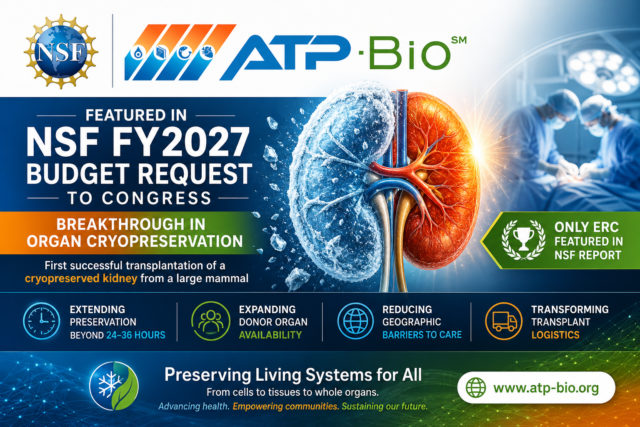
Minneapolis, MN—The National Science Foundation (NSF) Engineering Research Center for Advanced Technologies for the Preservation of Biological Systems (ATP-Bio℠) has been highlighted in the NSF’s FY2027 Budget Request to Congress, submitted to the White House on April 3, 2026.
“… NSF is prioritizing investments that have the greatest potential to address the most critical, high-priority challenges and opportunities identified by the Administration, Congress, and the science and technology community.”
ATP-Bio℠ was recognized for a major milestone achieved with Massachusetts General Hospital—the first successful transplantation of a cryopreserved kidney from a large mammal. Featured in the report’s official highlights (page 11), researchers removed, preserved, and transplanted a pig kidney back into a large animal with functional recovery.
This breakthrough addresses a critical limitation in transplantation: time. With organs currently viable for only 24–36 hours, extending preservation through advanced cryopreservation has the potential to transform how organs are stored, transported, and used in clinical care.
The implications are far-reaching—offering new pathways to:
- Expand the availability of donor organs
- Improve transplant outcomes
- Reduce geographic and logistical barriers to care
- Address global organ shortages
ATP-Bio℠’s inclusion in the NSF Budget Request underscores the Center’s growing national prominence and impact. Notably, ATP-Bio℠ was the only Engineering Research Center directly highlighted in the report—reflecting the significance of its contributions to science, medicine, and society.
ATP-Bio℠ is advancing technologies to preserve and extend the viability of living biological systems—from cells to tissues to whole organs—with applications spanning healthcare, agriculture, biodiversity, and sustainability.
About NSF ATP-Bio℠
NSF ATP-Bio℠ is a world-class partnership between engineering, medicine, science, education, business, and ethics at six premier research universities. It supports the crucial advancement of biopreservation technologies and enables innovation, commercialization, and diverse workforce development. Across NSF ATP-Bio℠, the institutional resources are abundant.
NSF ATP-Bio℠ is co-led by the University of Minnesota (UMN) and Massachusetts General Hospital (MGH). Texas A&M University and the University of California-Riverside are core collaborating institutions. The University of California-Berkeley and Carnegie Mellon University are affiliated partner institutions.
*This research was supported by the National Science Foundation under Grant No. EEC 1941543.*
Media Contact: Elica Gardner
ATP-Bio Communications Manager
atp-bio-aa@umn.edu