Press Release: October 15, 2026
Landmark Study Demonstrates First Successful Long-Term Cryopreservation and Nanowarming of Human-Scale Kidneys
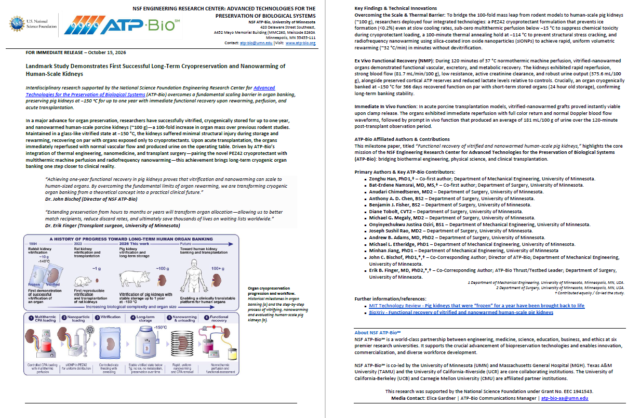
Interdisciplinary research supported by the National Science Foundation Engineering Research Center for Advanced Technologies for the Preservation of Biological Systems (ATP-Bio) overcomes a fundamental scaling barrier in organ banking, preserving pig kidneys at −150 °C for up to one year with immediate functional recovery upon rewarming, perfusion, and acute transplantation.
In a major advance for organ preservation, researchers have successfully vitrified, cryogenically stored for up to one year, and nanowarmed human-scale porcine kidneys (~100 g)—a 100-fold increase in organ mass over previous rodent studies. Maintained in a glass-like vitrified state at −150 °C, the kidneys suffered minimal structural injury during storage and rewarming, recovering on par with organs exposed only to cryoprotectants. Upon acute transplantation, the organs immediately reperfused with normal vascular flow and produced urine on the operating table. Driven by ATP-Bio’s integration of thermal engineering, nanomedicine, and transplant surgery—pairing the novel PEZ42 cryoprotectant with multithermic machine perfusion and radiofrequency nanowarming—this achievement brings long-term cryogenic organ banking one step closer to clinical reality.
“Achieving one-year functional recovery in pig kidneys proves that vitrification and nanowarming can scale to human-sized organs. By overcoming the fundamental limits of organ rewarming, we are transforming cryogenic organ banking from a theoretical concept into a practical clinical future.”
Dr. John Bischof (Director of NSF ATP-Bio)
“Extending preservation from hours to months or years will transform organ allocation—allowing us to better match recipients, reduce discard rates, and ultimately save thousands of lives on waiting lists worldwide.”
Dr. Erik Finger (Transplant surgeon, University of Minnesota)
READ THE FULL PRESS RELEASE
Further information/references:
- MIT Technology Review – Pig kidneys that were “frozen” for a year have been brought back to life
- BioXriv – Functional recovery of vitrified and nanowarmed human-scale pig kidneys
About NSF ATP-Bio℠
NSF ATP-Bio℠ is a world-class partnership between engineering, medicine, science, education, business, and ethics at six premier research universities. It supports the crucial advancement of biopreservation technologies and enables innovation, commercialization, and diverse workforce development. Across NSF ATP-Bio℠, the institutional resources are abundant.
NSF ATP-Bio℠ is co-led by the University of Minnesota (UMN) and Massachusetts General Hospital (MGH). Texas A&M University and the University of California-Riverside are core collaborating institutions. The University of California-Berkeley and Carnegie Mellon University are affiliated partner institutions.
*This research was supported by the National Science Foundation under Grant No. EEC 1941543.*